Crossref members register around 37,000 records daily. All this metadata is openly shared with the global scholarly community through our free APIs. We receive over two billion calls to our API each month, signalling its use by hundreds of tools and services worldwide, supporting the discovery and assessment of scholarly metadata. As part of a new series in our blog, we will spotlight the diversity of tools and integrations that rely on Crossref metadata to serve the scholarly community. In this initial post, we chat to Luca Foppiano, the developer and maintainer of Grobid1, to learn about how Grobid uses Crossref metadata to improve the extraction and enrichment of bibliographic information from scholarly PDFs.
On behalf of the Nominating Committee, I’m pleased to share the slate of candidates for the 2026 board election. Every active member organisation is invited to submit a ballot to elect the incoming board class.
We’re providing a summary of the board’s July 2026 meeting. The July board meeting is our only in-person meeting. The board gathers for two days of strategic thinking and long-range planning, as well as conducting annual board business. This year, we focused on allocating surplus funds we have on hand to invest in a three-year project to redesign the content system. In a related discussion, we decided to lower content registration fees starting in 2027 because we’ve had a demonstrated history of generating surpluses, exceeding what we need to run Crossref. We also discussed the board structure, as part of our regular review of stakeholder governance. And we conducted annual board business, such as approving the audited financial statements and reviewed our risk register and mitigation plans.
The resolutions are available on the dedicated section of our website, which also lists the members of the Board and offers further information about our governance.
We also managed to squeeze in watching a World Cup game over dinner.
Starting today, funder names deposited in Crossref metadata without an identifier will be matched to ROR IDs, to support an open and connected Research Nexus. Funding information is an increasingly important part of the scholarly record. The improved matching strategy supports researchers, funders, institutions, and meta-researchers, who rely on that information to understand how research is supported and what outcomes that support produces.
Many researchers want to carry out analysis and extraction of information from large sets of data, such as journal articles and other scholarly content. Methods such as screen-scraping are error-prone, place too much strain on content sites and may be unrepeatable or break if site layouts change. Providing researchers with automated access to the full-text content via DOIs and Crossref metadata reduces these problems, allowing for easy deduplication and reproducibility. Supporting text and data mining echoes our mission to make research outputs easy to find, cite, link, assess, and reuse.
In 2013 Crossref embarked on a project to better support Crossref members and researchers with Text and Data Mining requests and access. There were two main parts to the project:
To collect and make available full-text links and publisher TDM license links in the metadata.
To provide a service (TDM click-through service) for Crossref members to post their additional TDM terms and conditions and for researchers to access, review and accept these terms.
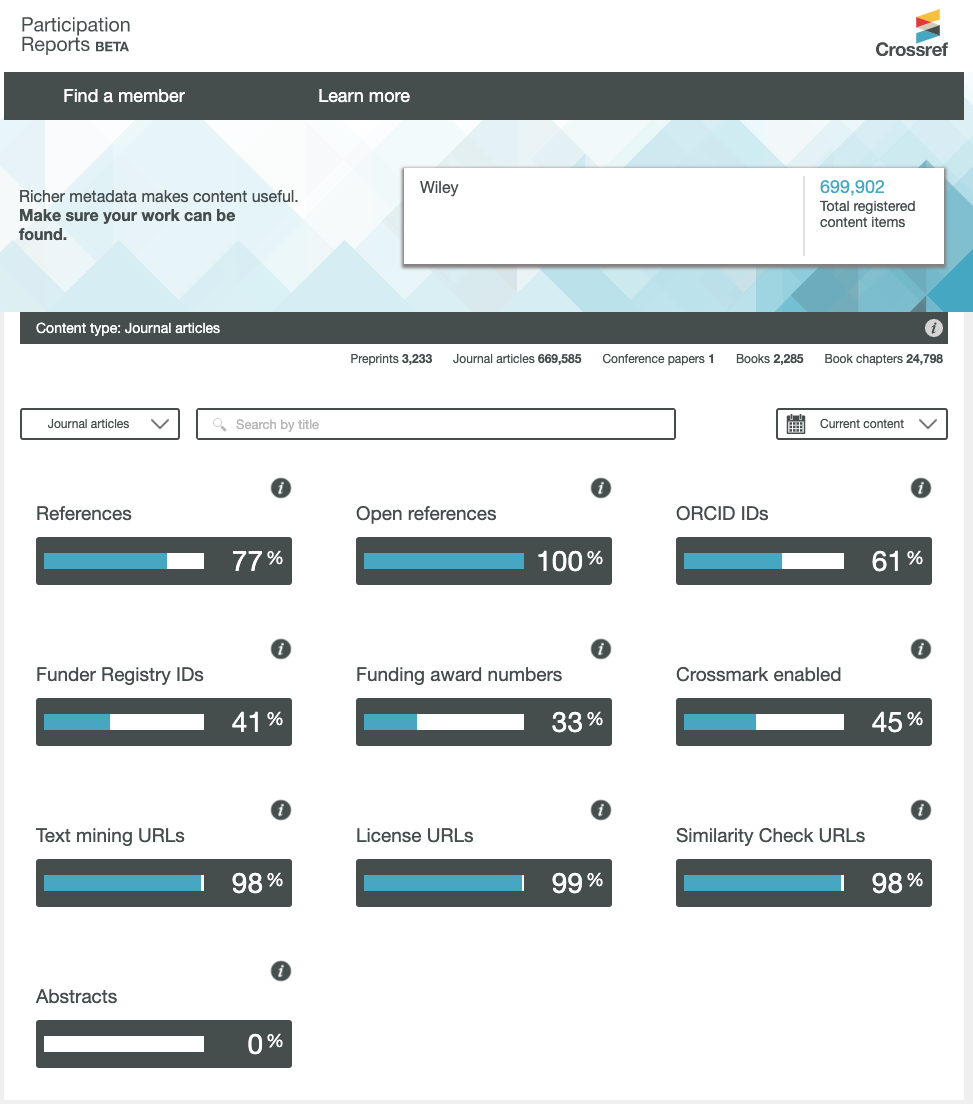
To date, 37.5 million works registered with Crossref have both full-text links and TDM license information. We continue to encourage all members to include full-text links and license information in the metadata they register to assist researchers with TDM. You can see how each member is doing via its Participation Report (e.g. Wiley’s).
Members are also making subscription content available for text mining (temporarily or otherwise) for specific purposes, such as to help the research community with its response to COVID-19. Back in April we highlighted how this can be achieved by including:
A “free to read” element in the access indicators section of publisher metadata indicating that the content is being made available free-of-charge (gratis)
An assertion element indicating that the content being made available is available free-of-charge.
To access Crossref’s click-through tool for text and data mining, users could log in via their ORCID iD. They could then review TDM license agreements posted by Crossref members and accept, reject or postpone their decisions until later. Having agreed to a publisher’s terms and conditions this action was logged against the user’s API token which they could use when requesting full-text from the publisher.
Since the pilot in 2014, only 2 publishers have continued with the tool and fewer than 300 API tokens have been issued.
Publishers have since developed their own mechanisms for managing TDM requests. The introduction of UK (2014) / EU (2019) copyright exceptions for TDM has significantly reduced the number of requests and at the same time, more and more content is published under an open access license.
Given the low take-up of the click-through by both publishers and researchers, its goals are no longer being met. Therefore we will retire the TDM click-through in December 2020. Until that date, it will still operate for the two publishers and various researchers who use it while they finish implementing their alternative plans.
Crossref will continue to collect member-supplied TDM licensing information in metadata for individual works, and researchers can continue to find this via the Crossref APIs.